HDF vs Solid Wood Bathroom Vanity: Which Holds Up Better?
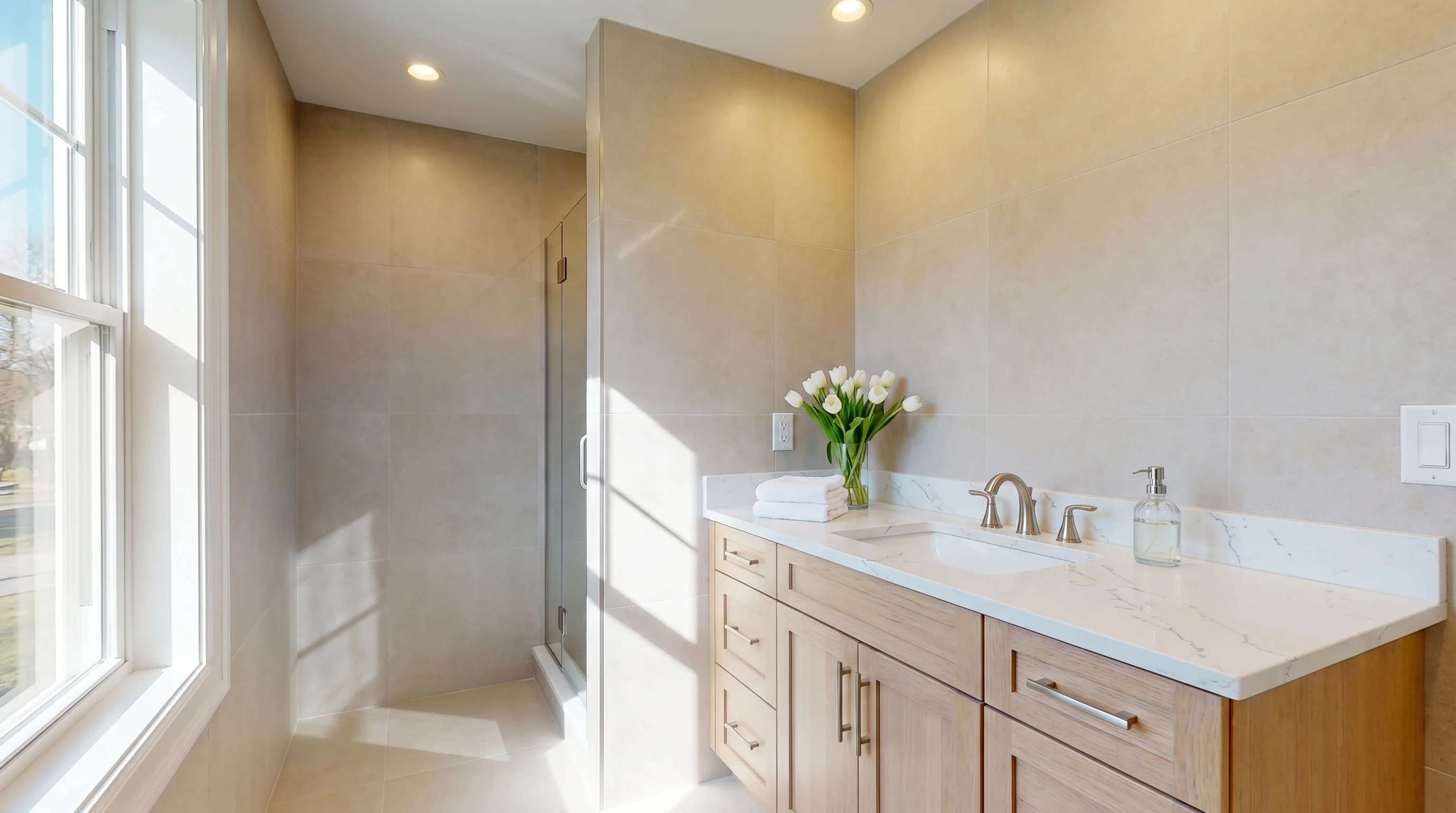
Most people assume solid wood is the better choice because it costs more and sounds more substantial. In a living room, that logic holds. In a bathroom — where humidity spikes every time someone showers, where condensation collects behind the cabinet, and where temperature swings happen daily — solid wood is often the wrong call. This guide breaks down exactly why, and what you should be looking for instead.
Why Solid Wood Struggles in a Bathroom Environment
Solid wood is a natural material, which means it expands and contracts with moisture and temperature. In a kitchen or bedroom, this movement is minimal and manageable. In a bathroom, it's a problem. Every hot shower sends humidity levels well above 70%. Over months and years, that cycle of moisture absorption and drying causes solid wood cabinet doors to warp, frames to rack, and finishes to peel at the joints.
This isn't a quality issue — it's a physics issue. Even well-made solid wood vanities from reputable manufacturers show this behaviour over time in bathrooms that see regular use. You can mitigate it with aggressive ventilation and careful sealing, but you can't eliminate it. The material was not designed for this environment.
Beyond warping, solid wood is also heavier, harder to machine consistently, and significantly more expensive to produce. That cost gets passed to you without a corresponding benefit in a space where the material's natural properties work against it.
What HDF Actually Is — and Why It Performs Better Here
HDF stands for High-Density Fiberboard. It's an engineered wood product made by compressing wood fibres under high heat and pressure with resin binders. The result is a panel that is denser and more dimensionally stable than solid wood, MDF, or particleboard.
The key word is dimensionally stable. Because HDF is engineered rather than grown, it doesn't have the grain structure that causes wood to move with moisture. When properly sealed and finished — which is standard in a quality vanity — HDF resists humidity far better than solid wood in real bathroom conditions.
HDF also machines cleanly and consistently, which is why it's the preferred substrate for soft-close hinge systems and precision-fit drawer boxes. Solid wood's natural variation in grain and density can make consistent machining harder, especially at scale.
One important distinction: HDF is not the same as cheap particleboard or low-density MDF. Particleboard is light, crumbly, and genuinely poor in wet environments. If you've had a budget vanity fall apart at the cabinet bottom where water pools, that was likely particleboard. HDF is a different product — denser, stronger, and built for durability.
The Real Cost Difference Between HDF and Solid Wood Vanities
A solid wood bathroom vanity — just the cabinet, no countertop, no sink — typically starts around $800 to $1,200 for a 30-inch unit from a mid-range supplier. Add a quartz countertop (usually $300–$600 cut to size), an undermount ceramic sink ($80–$150), and hardware, and you're looking at $1,200 to $2,000 before installation for a single-sink setup.
A complete HDF vanity set from Modern Vanity — cabinet, quartz countertop, ceramic undermount sink, backsplash, and brushed nickel hardware — starts at $499 for a 24-inch unit and goes to $1,299 for a 60-inch double-sink configuration. Everything is included. Nothing needs to be sourced separately or cut to fit.
You're not getting a lesser product by choosing HDF. You're getting a material that's better suited to bathrooms, at a price that reflects smarter engineering rather than premium markup on a material that doesn't belong in this environment.
Browse the full range at Shop All Vanities to see current sizing and colour options.
What to Check Before Buying Any Vanity — Regardless of Material
Material is one factor. Construction quality is another, and the two don't always correlate with price. Here's what actually matters when evaluating a vanity cabinet:
- Cabinet bottom thickness and sealing: This is where water damage starts. A thin, unsealed cabinet bottom will fail first, regardless of whether the rest of the cabinet is solid wood or HDF.
- Hinge and drawer slide quality: Soft-close hardware is the standard for a reason — it reduces impact stress on the cabinet over thousands of open/close cycles. If a vanity ships with basic hinges, factor in replacement cost.
- Back panel construction: Some budget vanities have open backs or thin cardboard-style panels. In a bathroom with any wall moisture, this matters.
- Countertop integration: A vanity with a countertop that was designed and cut for that specific cabinet will fit and seal better than a countertop sourced separately and retrofitted.
- Assembly quality: Cabinets assembled in Canada or locally tend to have tighter quality control than flat-pack units assembled by the end buyer.
If you're comparing a 30-inch vanity specifically, the 30" vanity options at Modern Vanity include all of the above — soft-close doors and drawers, assembled HDF cabinet, integrated quartz top, and ceramic undermount sink — as a complete unit.
Which Material Should You Actually Choose?
For a primary bathroom that sees daily use, a powder room, or any bathroom without exceptional ventilation: choose HDF over solid wood. The performance advantage in humidity resistance is real, the price difference is significant, and you're not sacrificing anything that matters in a bathroom context.
Solid wood makes sense in furniture applications where its natural character and repairability are genuine advantages. A bathroom vanity is a functional fixture that needs to hold up to moisture, daily handling, and cleaning products for a decade or more. HDF is engineered for exactly that.
Modern Vanity carries complete HDF vanity sets in White, Grey, and Blue, in sizes from 24 inches to 60 inches, with free warehouse pickup in the GTA or delivery options starting at $140. Everything is ordered online — if you have questions about sizing or which configuration works for your bathroom, message us on WhatsApp at (647) 428-1111 before you order.
Ready to compare sizes and configurations? Browse the full vanity collection or check the FAQ for delivery and installation details.