How to Cut a Plumbing Hole in a Bathroom Vanity Cabinet
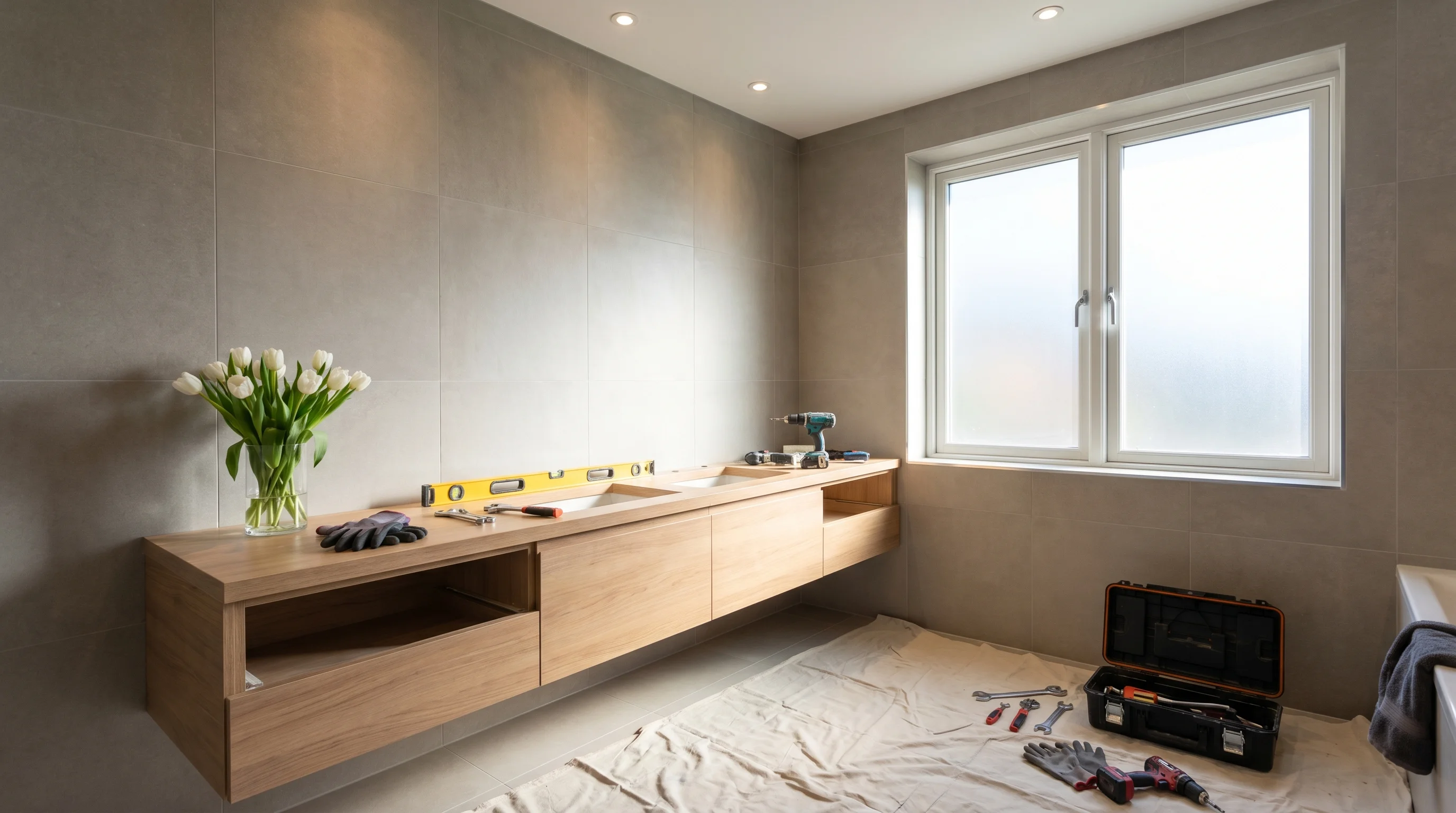
Cutting plumbing holes in a vanity cabinet is the step most DIYers rush — and regret. Get the measurements wrong by even half an inch and your drain sits off-center, your supply lines kink against the cabinet wall, or you crack the back panel trying to force a fitting through a hole that's just slightly too small. This guide walks you through the entire process: what to measure, what to cut, and how to avoid the mistakes that turn a Saturday project into a two-weekend ordeal.
Tools and Materials You Need Before You Start
Don't improvise this with whatever's in the garage. The right tools make the difference between a clean hole and a splintered cabinet panel.
- Jigsaw with a fine-tooth wood blade (10–12 TPI) — for cutting the drain hole
- Hole saw kit — 1-3/8" for supply line holes is standard; have a 1-1/2" on hand as backup
- Drill with a pilot bit — to start jigsaw cuts cleanly
- Tape measure and pencil
- Painter's tape — applied over the cut area prevents splintering on finished cabinet panels
- Utility knife — score along cut lines before sawing to reduce tear-out
- Flashlight or headlamp — you'll be working inside a dark cabinet
- Safety glasses
If your vanity cabinet has an HDF back panel (as most quality assembled cabinets do), a sharp blade matters more than raw power. Dull blades cause tear-out and can crack the panel. Replace the blade if it's been used on anything else recently.
The Measurements That Actually Matter
Before cutting anything, you need three measurements from your rough plumbing — not from a diagram, not from memory. Measure from the actual wall.
- Drain center position (left-right): Measure from the nearest side wall to the center of your drain stub-out. This tells you where the drain hole needs to land relative to the cabinet's left or right edge.
- Drain height from floor: Most P-trap connections sit between 14" and 18" from the finished floor. Measure yours. The drain hole in the cabinet back panel needs to be at least 2" taller than your stub-out to allow for the P-trap curve.
- Supply line positions: Hot and cold supply lines are typically 3" to 4" apart, centered under where the faucet will sit. Measure their height from the floor and their horizontal position from the wall corner.
Write these numbers down. Then position your vanity cabinet in place (without pushing it fully against the wall) and transfer the measurements onto the back panel using a pencil. Mark the center of each hole clearly.
Pro tip: For the drain hole, mark a circle that's at least 4" in diameter. The P-trap assembly needs room to move during installation and adjustment. A tight hole makes connecting the drain a frustrating, knuckle-scraping exercise.
How to Cut the Drain Hole (Back Panel)
This is the most common cut — a large-ish opening in the back panel to accommodate the P-trap and drain tailpiece.
- Apply painter's tape over your marked circle on the finished (exterior) side of the back panel.
- Re-mark your circle on top of the tape.
- Drill a pilot hole just inside the circle line — large enough to fit your jigsaw blade.
- Insert the jigsaw blade into the pilot hole and cut along the inside edge of your circle. Go slow on the curves.
- Sand the cut edge lightly. Rough edges can snag supply lines and make future access harder.
If your cabinet has a thicker back panel or a reinforced bottom rail near the floor, a reciprocating saw with a short wood blade gives you more control in tight spots.
How to Cut Supply Line Holes
Supply line holes are smaller and more precise. Standard flexible braided supply lines need a hole of 1-3/8" to 1-1/2" diameter. Use a hole saw, not a jigsaw — you want clean, round holes here.
- Mark the center of each supply line position on the back panel.
- Apply painter's tape over both marks.
- Drill slowly with your hole saw. Let the saw do the work — forcing it through HDF causes heat and tear-out.
- Deburr the edges with a utility knife or sandpaper.
If your supply lines come up through the floor (rather than the wall), cut the holes in the cabinet floor panel using the same hole saw method. Measure from the cabinet's front edge and side edge to locate the holes accurately before cutting.
Why Pre-Assembled Vanities Make This Easier
One underappreciated advantage of buying a fully assembled vanity — like the sets available at Modern Vanity — is that the cabinet arrives as a rigid, finished unit. You can lay it on its back on a workbench, take your time marking, and cut cleanly without the cabinet flexing or panels shifting around.
Our vanities use HDF cabinet construction with soft-close hinges and drawers, assembled in Canada. The back and floor panels are consistent thickness, which means your hole saw cuts predictably. No surprises mid-cut.
Sizes run from 24" up to 60", and every set includes the quartz countertop, ceramic undermount sink, and brushed nickel hardware — so once your plumbing holes are cut and the cabinet is set, you're not waiting on separate countertop delivery. If you're working with a smaller bathroom, the 30" vanities are a practical starting point — enough cabinet space to work with, and the drain position is straightforward to center.
Prices start at $499 for a 24" complete set and go up to $1,299 for a 60" double-sink configuration. Everything ships to the GTA — free warehouse pickup, $140 for garage delivery, or $200 for inside-the-home delivery.
Before You Push the Cabinet Into Place
A few final checks before sliding everything against the wall:
- Test-fit your P-trap through the drain hole before the cabinet is against the wall. You want to confirm it passes through cleanly and that you have enough range of motion to connect to the drain stub-out.
- Feed supply lines through their holes before positioning the cabinet. It's much harder to thread them through once the cabinet is in place.
- Check for level — shim the cabinet base if needed before connecting any plumbing. A level cabinet means a level countertop and properly functioning soft-close doors.
- Caulk the back panel holes around your supply lines once everything is connected. This prevents moisture from getting behind the cabinet.
If you run into something unexpected — unusual drain height, supply lines that are further apart than standard, or a back panel that's thicker than expected — (647) 428-1111 is our WhatsApp line. Send a photo and we can usually give you a straight answer fast.
Browse the full range at modernvanity.ca, or check the FAQ if you have questions about dimensions and rough-in specs before ordering.