Bathroom Renovation Order of Operations: What to Do First
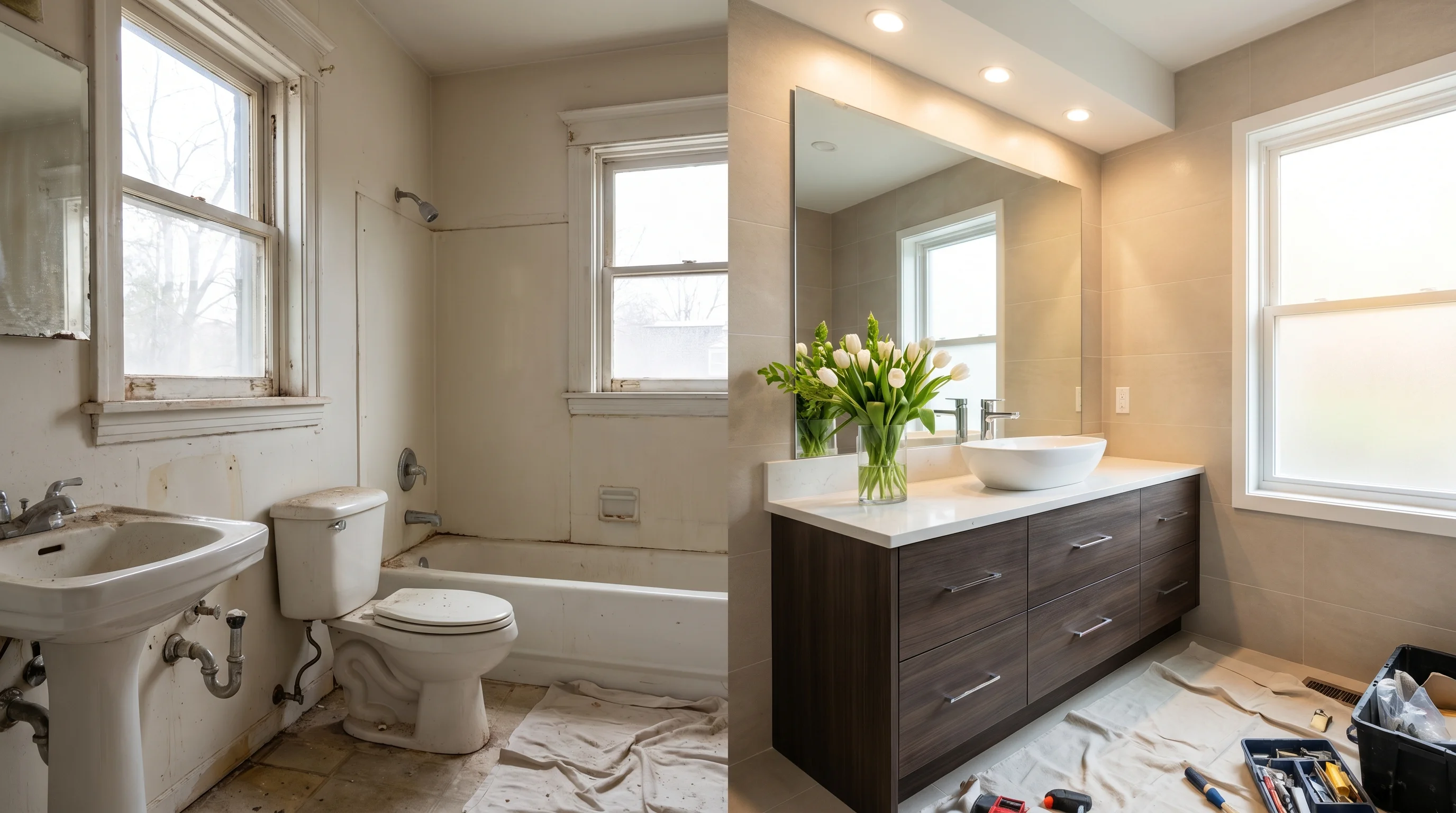
Most bathroom renovations don't fail at the demo stage or the tile stage. They fail at the planning stage — specifically, when homeowners pick a paint colour before they've confirmed their vanity size, or book a plumber before they know where the drain is going. The order you make decisions in a bathroom reno matters more than almost any individual decision itself.
Start With Measurements, Not Mood Boards
Before you save a single Pinterest image, measure your bathroom. Not approximately — actually. Floor-to-ceiling height, wall-to-wall width, and critically: the distance from your existing drain rough-in to the nearest wall. That drain location is the single biggest constraint in your entire renovation. It determines what vanity sizes are even viable, whether you need a plumber to relocate anything, and how much your project will cost.
For most Toronto-area bathrooms, you're working with one of a few standard configurations: a narrow main bath (typically 5x8 feet), a powder room (roughly 3x6), or a larger ensuite. Each has a practical vanity size ceiling. A 24-inch vanity is the minimum for a functional powder room; a 60-inch double-sink vanity needs at least 7 feet of clear wall space once you account for door swing and toilet clearance. Get the measurements right before anything else.
The Decision Sequence That Actually Works
Here's the order professional renovators and experienced GCs follow — and the logic behind each step:
- Confirm scope and structural constraints. Is this a cosmetic refresh or are you moving walls, relocating plumbing, or adding electrical? Moving a drain in a concrete slab (common in older Toronto homes and condos) can add $800–$2,500 to your budget before a single tile goes down. Know this upfront.
- Select your vanity first. This is the anchor decision. Your vanity determines drain placement, countertop height, mirror sizing, lighting rough-in height, and the visual weight of the whole room. Everything else — tile, paint, hardware finishes — should coordinate with the vanity, not the other way around. Browse the full vanity range to understand what sizes and finishes are available before you commit to anything else.
- Book your trades in order. Plumber first (rough-in and drain confirmation), then tile setter, then electrician for lighting, then the vanity installation itself. In the GTA, expect 2–4 week lead times for licensed plumbers and tile setters, especially in Q1 and Q4 when everyone is renovating.
- Order materials with buffer time. Tile, vanities, mirrors, and fixtures all have lead times. If your vanity is backordered, your entire trade schedule gets pushed. Order as soon as you've confirmed measurements and scope.
- Paint and accessories last. Paint is the easiest thing to change and the cheapest. Do it after the vanity and tile are in so you're matching to fixed elements, not guessing.
Why the Vanity Is the Highest-Impact Decision in the Room
In a typical bathroom renovation, the vanity and countertop combination represents the largest single visual surface the eye lands on. It also anchors the plumbing, sets the storage footprint, and establishes the hardware finish that should carry through to towel bars, toilet paper holders, and faucets.
Buying these components separately — cabinet from one supplier, countertop from another, sink from a third — is where budgets quietly explode. A quartz countertop alone, custom-cut, starts at $400–$700 for a standard bathroom size before fabrication and installation. A ceramic undermount sink adds another $80–$200. A separate cabinet, even a basic one, runs $300–$600. You're easily at $800–$1,500 before hardware, and nothing is guaranteed to fit together cleanly.
Complete vanity sets — cabinet, quartz countertop, ceramic undermount sink, backsplash, and brushed nickel hardware included — eliminate that coordination problem entirely. At Modern Vanity, sets start at $499 for a 24-inch and go up to $1,299 for a 60-inch double-sink configuration, available in White, Grey, and Blue. The 30-inch vanities are the most popular size for Toronto main bathrooms and powder rooms — enough storage to be functional, compact enough to work in tighter layouts.
Realistic Budget Ranges for a GTA Bathroom Renovation
Here's what a mid-range bathroom renovation actually costs in the Greater Toronto Area in 2024–2025, broken down by category:
- Vanity (complete set): $499–$1,299
- Toilet: $250–$600 (standard to comfort height)
- Tile (materials only): $3–$12 per sq ft, plus $8–$15 per sq ft for labour
- Plumbing labour: $400–$1,200 depending on scope
- Electrical (new fixture/exhaust fan): $200–$600
- Mirror and lighting: $150–$500
- Painting: $200–$500 (DIY saves most of this)
- Miscellaneous (caulk, demo, disposal): $100–$300
A realistic mid-range bathroom renovation — new vanity, new tile, new toilet, updated lighting — lands between $4,000 and $8,500 for most GTA homeowners using licensed trades. Cosmetic-only refreshes (vanity swap, paint, accessories) can come in well under $2,000 if the plumbing rough-ins stay in place.
The Delivery and Installation Piece Most People Underplan
Once you've ordered your vanity, have a clear plan for getting it from the truck to the bathroom. A 60-inch vanity is heavy, assembled, and won't fit through a narrow hallway at an angle. Modern Vanity offers free warehouse pickup, $140 garage delivery, or $200 inside-the-home delivery across the GTA. If you're on an upper floor of a condo or townhouse, factor that into your installation timeline — your contractor needs the vanity on-site before they can complete the plumbing rough-in.
Have questions about sizing, delivery logistics, or which configuration fits your layout? Message us on WhatsApp at (647) 428-1111 — it's the fastest way to get a straight answer.
When you're ready to start comparing options, shop the full vanity collection online. Every set ships with everything you need to hand off to your plumber — no separate countertop sourcing, no hardware hunting, no surprises.