Bathroom Vanity Lighting: Placement Rules That Actually Work
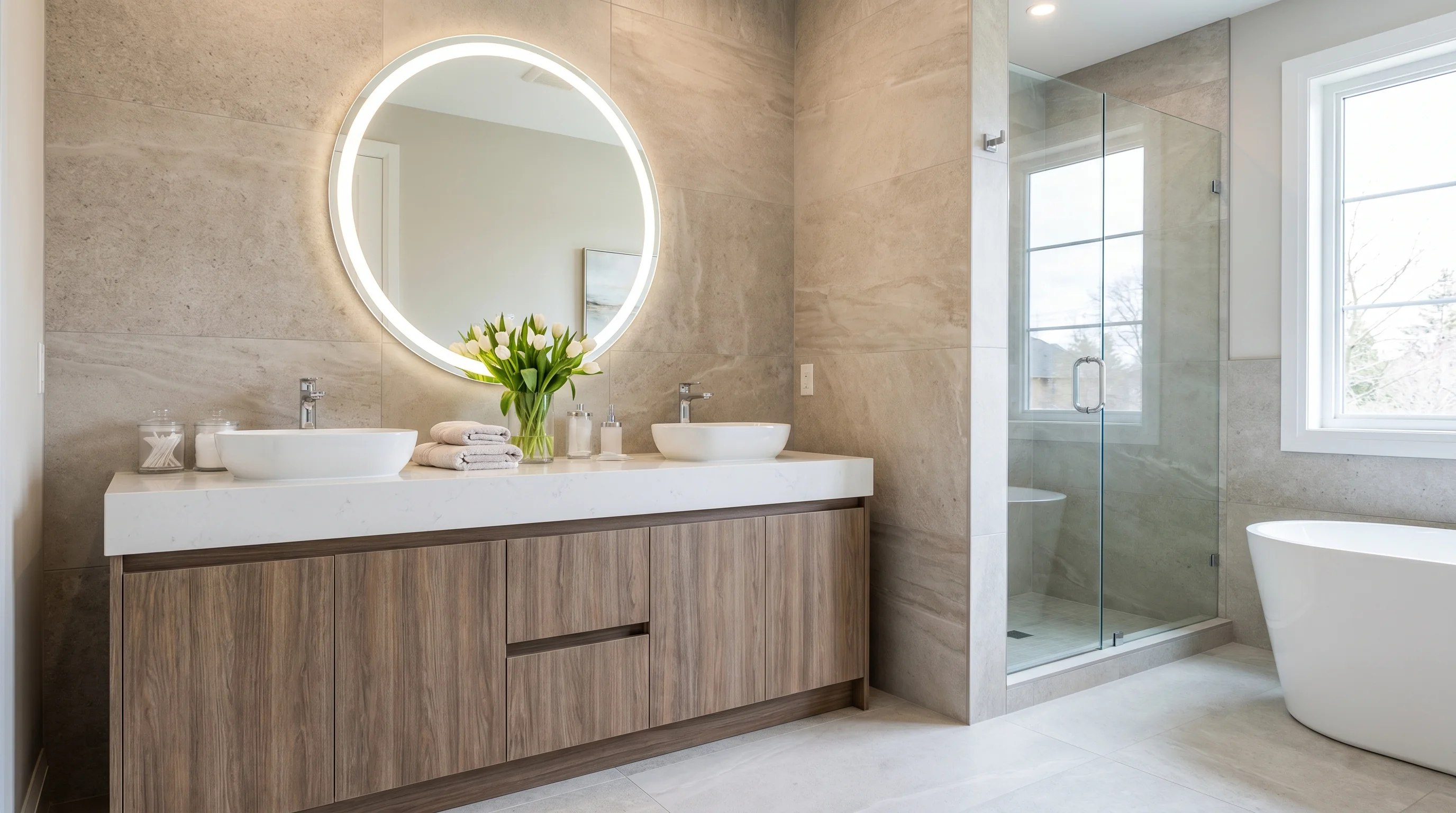
Most bathroom lighting mistakes happen before a single fixture is purchased. People pick a light they love online, mount it above the mirror, and then wonder why their reflection looks like it's lit by a parking garage. The problem isn't the fixture — it's the placement. Vanity lighting is one of the few areas in interior design where the physics of shadow and reflection matter more than aesthetics, and once you understand that, every other decision gets easier.
Why Above-Mirror Lighting Creates Shadows (And What to Do Instead)
A single bar light mounted directly above the mirror is the default in most builder-grade bathrooms — and it's also the worst option for task lighting. Light coming from directly above casts shadows under your nose, chin, and eye sockets. It's unflattering and functionally poor for anything requiring precision: shaving, applying makeup, skincare routines.
The gold standard is side-mounted sconces at eye level, positioned on either side of the mirror at approximately 60 to 65 inches from the floor (measured to the centre of the fixture). This mirrors the lighting setup used in professional makeup studios because it eliminates directional shadow across the face. If your bathroom layout only allows for overhead lighting, mount the bar as close to eye level as the mirror permits — ideally no higher than 75 to 80 inches from the floor.
For vanities 48 inches wide or larger, a combination approach works well: a horizontal bar above the mirror plus two flanking sconces. This wraps the face in even light and eliminates virtually all shadow. It's also the approach that makes a double-sink vanity feel intentional rather than just large.
Matching Fixture Widths to Your Vanity Size
A common mistake is choosing a light bar that's either too narrow or wider than the mirror itself. The fixture width should be roughly 75% of the mirror's width — so for a mirror above a 36-inch vanity, you're looking at a bar in the 24 to 28-inch range. Going wider than the mirror creates visual imbalance; going narrower concentrates the light too much toward the centre.
For sconces flanking a mirror, the fixture face should sit 2 to 4 inches from the mirror's edge. This keeps the light source close enough to the face without the fixture appearing to crowd the mirror.
If you're still choosing your vanity size, browsing the full vanity lineup by dimension first makes it easier to plan your lighting layout before you commit to anything.
How Vanity Colour Changes Your Lighting Needs
The finish of your vanity cabinet affects how much ambient light bounces around the room — and that changes what kind of lighting you need.
White vanities reflect light well. In a smaller bathroom, a white cabinet with warm-white bulbs (around 2700K to 3000K) creates a bright, clean feel without requiring high wattage. Brushed nickel fixtures — which are included with every Modern Vanity set — pair naturally with white cabinetry and work with both warm and cool bulb temperatures.
Grey vanities are more neutral and absorb slightly more light than white. They pair well with fixtures in matte black, brushed nickel, or chrome. If your grey vanity is in a bathroom with limited natural light, lean toward 3000K to 3500K bulbs — warm enough to feel comfortable, cool enough to keep the grey from reading as dark or heavy.
Blue vanities are the most colour-sensitive of the three. Cool-white bulbs above 4000K can push a navy or slate blue vanity into a cold, clinical feel. Stick with 2700K to 3000K for warmth, and consider fixtures with an amber or antique brass finish to add contrast. A warm-toned light against a blue cabinet creates a high-contrast look that's become popular in boutique hotel bathrooms for good reason.
Recessed Lighting: Useful Supplement, Poor Primary Source
Pot lights above the vanity area are useful for general ambient light but should never be the primary task light source. A single recessed fixture directly above the mirror creates the same overhead shadow problem as a poorly placed bar light — worse, actually, because the beam is more concentrated.
If your bathroom has or will have recessed lighting, position the pot lights approximately 18 to 24 inches in front of the mirror, not directly above it. This angles the light forward onto the face rather than straight down onto the top of the head. Pair this with side sconces and you have a layered lighting setup that handles both task and ambient needs.
For smaller bathrooms — those built around a 24-inch or 30-inch vanity — recessed lighting often isn't necessary at all. A well-placed bar or two sconces does the job without crowding a tight ceiling. If you're working with a compact footprint, 30-inch vanities are worth looking at for spaces where every inch of planning counts.
Dimmer Switches: The Upgrade Most People Skip
Vanity lighting serves two very different functions depending on the time of day. Morning and task lighting needs to be bright and accurate — 75 to 100 watts equivalent per side for sconces, or a bar in the 1600 to 2400 lumen range. Evening bathroom use — before bed, late-night trips — benefits from much lower intensity.
A dimmer switch costs between $20 and $60 and works with most modern LED fixtures. It's one of the highest-return upgrades in a bathroom renovation relative to its cost. The one caveat: confirm your bulbs are rated as dimmable before purchasing. Not all LED bulbs are, and non-dimmable LEDs will flicker or buzz on a dimmer circuit.
If you're planning a bathroom renovation and want to talk through how your vanity choice affects lighting layout, you can reach us on WhatsApp at (647) 428-1111 — it's the fastest way to get a straight answer.
Putting It Together
Good vanity lighting comes down to three things: source position (side beats overhead for task lighting), fixture scale (match to your mirror width), and colour temperature (match to your cabinet finish and the mood you want). Get those right and the fixture style — whether it's a sleek bar, globe sconces, or an industrial cage — becomes a finishing detail rather than a structural decision.
If you're still in the planning stage, shop the full vanity collection to find the right size and colour before locking in your lighting layout. Complete sets — cabinet, quartz countertop, ceramic sink, backsplash, and brushed nickel hardware — start at $499 for a 24-inch and go up to $1,299 for a 60-inch double-sink. More planning resources are available in the blog archive if you're working through a larger renovation.