What to Look for in a Budget Bathroom Vanity (Without Getting Burned)
Most people shopping for a budget bathroom vanity make the same mistake: they compare the sticker price without comparing what's actually in the box. A vanity listed at $350 with no countertop, no sink, and no hardware will cost you $600 by the time you're done. Meanwhile, a complete set at $499 is genuinely $499. The price on the tag means nothing until you know exactly what it includes.
The Real Cost of Buying a Countertop Separately
This is where budget vanity shopping gets expensive fast. A lot of entry-level vanities — especially from big box stores — sell the cabinet only. You then need to source a countertop, a sink, a faucet, drain hardware, and sometimes a backsplash separately. Here's what that typically adds up to in the GTA:
- Quartz countertop (cut to size): $150–$400 depending on thickness and supplier
- Undermount ceramic sink: $80–$180
- Drain assembly: $25–$60
- Backsplash tile or panel: $40–$120
That's $300 to $760 on top of the cabinet price — before a plumber touches anything. A vanity set that bundles all of this at $499 for a 24-inch or $1,299 for a 60-inch double sink isn't just convenient. It's often genuinely cheaper, and you're not spending three weekends sourcing matching components.
When you're evaluating any budget vanity, the first question to ask is: does this price include the countertop, sink, and hardware — or just the cabinet?
Cabinet Material: What Actually Holds Up in a Bathroom
Bathroom cabinets live in a humid, wet environment. The material matters more here than almost anywhere else in the house. Here's what you'll typically encounter at the budget end of the market:
- Particleboard: The cheapest option. Absorbs moisture, swells, and degrades over time — especially around the sink area. Common in the lowest-priced vanities.
- MDF (Medium Density Fiberboard): Better than particleboard, more consistent surface, but still moisture-sensitive if the finish is compromised.
- HDF (High Density Fiberboard): Denser and more moisture-resistant than MDF. Holds screws better, less prone to warping. A meaningful step up without the price jump to solid wood.
- Solid wood or plywood: The premium option — durable, but rarely found at the budget price point.
For a bathroom vanity in the $499–$1,299 range, HDF is the sweet spot. It performs well in bathroom conditions and holds up to daily use. If a vanity at that price point is using particleboard, that's a red flag worth taking seriously.
Soft-Close Hardware: Small Detail, Real Difference
This sounds like a luxury add-on, but soft-close hinges and drawer slides are now standard on any vanity worth buying — even at the budget level. Here's why it matters practically: bathroom doors and drawers get opened and closed dozens of times a day, often by wet hands, often in a hurry. Cheap hinges loosen. Drawers with basic slides start sticking within a year. Soft-close mechanisms reduce the wear on the cabinet frame itself, not just the noise.
If a vanity at the $500–$700 price point doesn't include soft-close doors and drawers, that's a cost-cutting decision that will show up in the product's lifespan. It's worth paying attention to.
Size Reality Check: What Actually Fits Your Bathroom
Vanity sizes run from 24 inches to 60 inches, and the right choice depends on two things: the physical space you have, and what you actually need to store. A few specifics worth knowing:
- 24-inch vanities are designed for small bathrooms and powder rooms. Storage is limited — typically one door, maybe one drawer. Good for a guest bath, not practical as a primary bathroom vanity for two people.
- 30-inch and 36-inch vanities are the most common size for a single-sink primary bathroom. The extra 6 inches over a 24" makes a real difference in counter space and cabinet depth. 30" vanities are a good starting point if you're unsure.
- 48-inch and 60-inch double-sink vanities work for shared master bathrooms, but measure your rough-in plumbing before committing — moving drain lines adds cost.
One thing people underestimate: the depth of the cabinet matters as much as the width. Standard vanity depth is 21 inches. Some budget options shave this down to 18 inches to reduce material cost. That 3-inch difference is noticeable when you're actually using the counter.
Before you order anything, measure the width of your space, account for door swing clearance, and confirm your rough-in plumbing location. Our FAQ covers the key measurements to take before ordering.
What a Good Budget Vanity Actually Looks Like
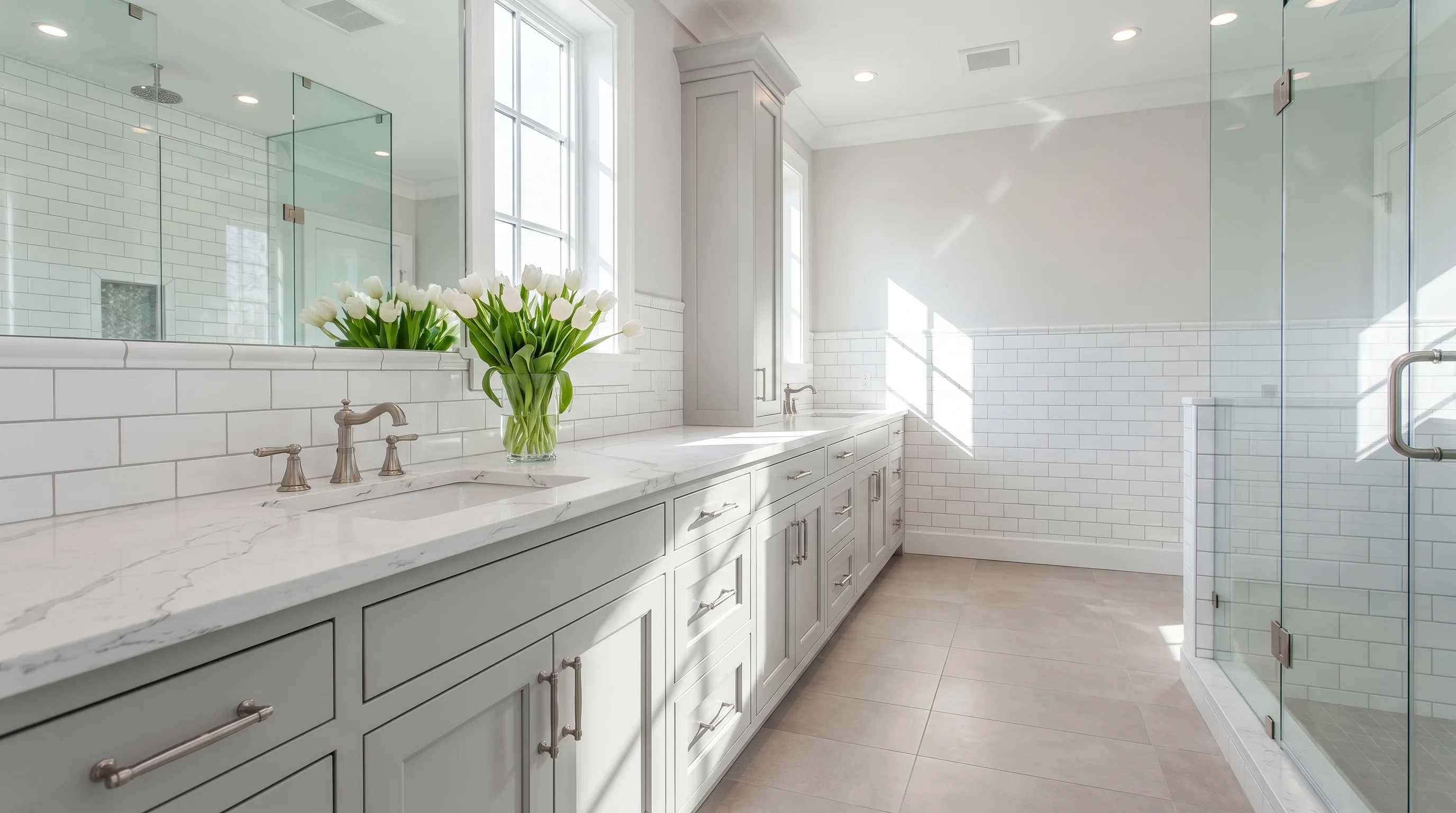
To make this concrete: a genuinely good budget vanity at the $499–$800 price point should include an HDF cabinet with a moisture-resistant finish, a quartz or engineered stone countertop (not laminate), a ceramic undermount sink, soft-close doors and drawers, brushed nickel or matte black hardware, and a backsplash. That's a complete, install-ready set.
The vanities at Modern Vanity check all of those boxes — complete sets starting at $499 for a 24-inch, available in White, Grey, and Blue, with quartz countertops, ceramic undermount sinks, and brushed nickel hardware included. Assembled in Canada, delivered to the GTA. Browse all sizes and colours here.
If you have specific questions about sizing or what's included, message us on WhatsApp at (647) 428-1111 — it's the fastest way to get a straight answer.
And if you're still in the research phase, our guides cover installation, sizing, and what to expect from GTA delivery — all worth reading before you commit to anything.